
Acne / Pores / ScarsElysées RF Laser for enlarged pores and acne scars

Elysées RF Laser for enlarged pores and acne scars
Elysées RF is a treatment technique that directly applies micro-needles to the skin, then delivers high-frequency (RF) energy to the dermis layer. The penetration depth of the micro-needles can be adjusted to suit the different areas and conditions of the skin, as well as the specific characteristics of the lesions to be treated. A key feature is the ability to select between two frequencies: 1MHz and 2MHz. For example, for deep acne scars or enlarged pores, a 1MHz frequency is used, while for improving fine wrinkles or facial redness, where a more concentrated response on the skin surface is needed, a 2MHz frequency is utilized to deliver customized energy. This approach is expected to help with various skin concerns, including the improvement of acne scars and pores, as well as fine wrinkle management, enhanced skin elasticity, and reduction of redness. *VAT not included
Options
Treatment Details


Elysis Needle Fractional RF
Our focus is on maximizing the improvements that can be expected at similar treatment intensities.
Elysis RF uses micro-needles to directly deliver high-frequency energy to the dermal layer of the skin.
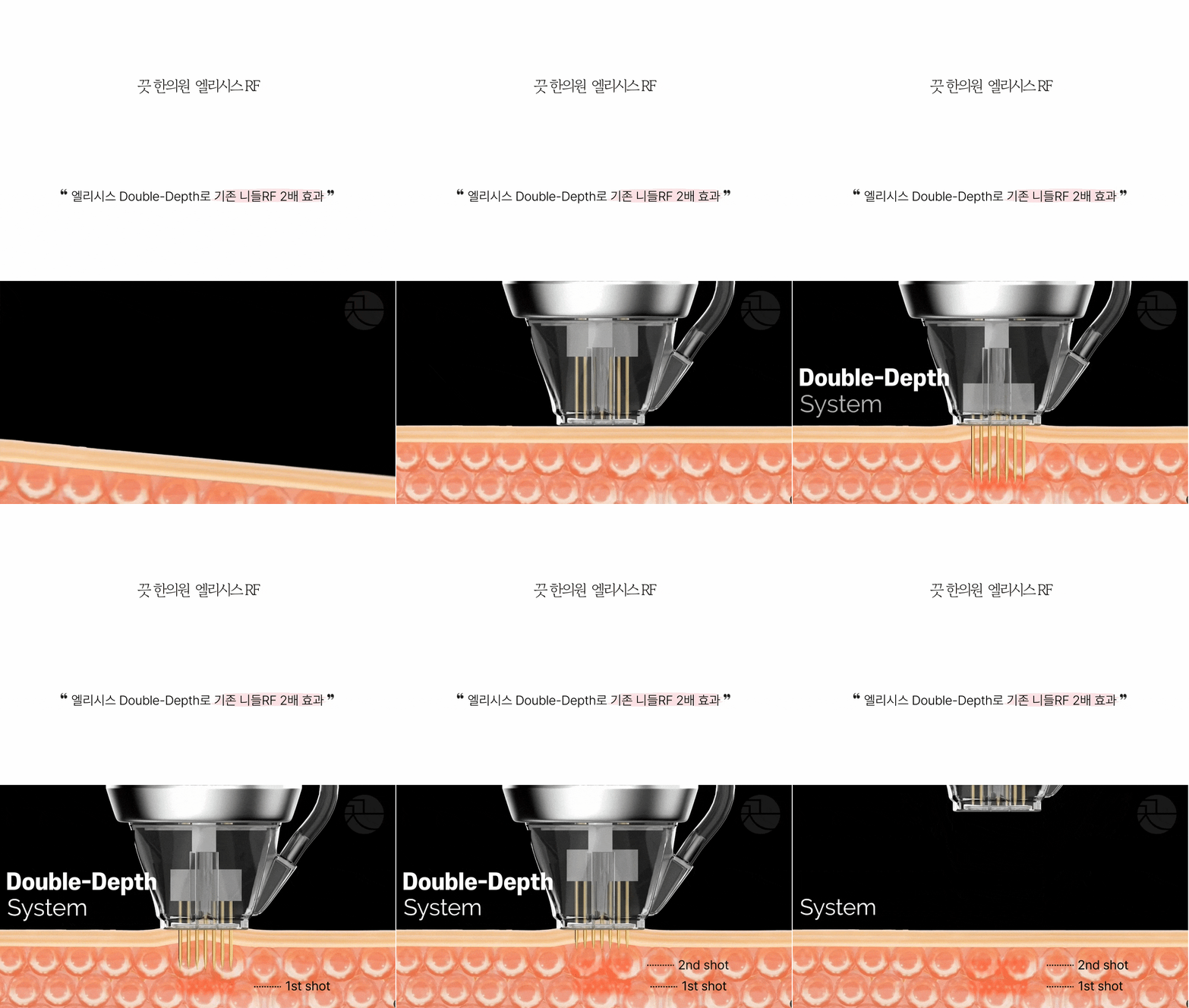
The principle is similar to existing needle radiofrequency treatment devices. However, it can selectively apply 1MHz and 2MHz frequencies as needed, and utilizes a 49-pin non-insulated tip and an insulated tip structure capable of delivering energy to two depths.
This makes it a needle RF device capable of a comprehensive approach to various skin concerns with just one treatment.
Elysis RF: What features can lead to efficient management?
1) 49-pin Non-Insulated Tip: A structure that increases stimulation density and area compared to conventional tips
This non-insulated tip aims to improve pores and acne scars.
When the tip makes contact once to deliver energy, more electrodes widely and uniformly stimulate the dermal layer.
This increases the density of micro-coagulation zones formed by heat, which can positively impact pore and skin texture improvement.
Therefore, more effective stimulation can be delivered to the skin within the same treatment time and pain tolerance.
2) Insulated Dual-Depth (2-depth) Structure: Continuous delivery to two depths with a single needle contact
This is an insulated tip that can be used for fine wrinkle and lifting improvement.
While other insulated tips stimulate shallow and deep layers individually, Elysys's insulated tip delivers energy consecutively to two different depths with a single needle insertion.
This method protects the epidermis, reducing recovery burden, while contributing to remodeling through collagen rearrangement in the deep dermal layer.
3) 1MHz and 2MHz Frequency Selection
1MHz (Low-Frequency Range): High-frequency current can be delivered deep into the skin, making it useful for lifting, elasticity improvement, deep wrinkles, enlarged pores, and improving the base of scars.
2MHz (Relatively High-Frequency Range): Primarily reacts from the epidermis to the upper dermal layer, contributing to sebum gland control, pore surroundings, fine wrinkles, skin texture improvement, and redness reduction.
Unlike conventional needle RF treatments, this allows for a more delicate response to skin concerns by switching or sequentially applying 1MHz (deep layer) and 2MHz (surface layer) frequencies within a single session.
4) Principle of Aiming for 350+ Shots per Treatment
For a typical full-face treatment, approximately 300 shots are applied based on 2 passes, with an additional 50 shots overlapped on key problem areas, meticulously performing at least 350 shots or more.
Through Elysys's 49-pin non-insulated tip and dual-depth insulated tip structure, more comprehensive skin care can be expected with the same number of treatment sessions.
5) Precise Diagnosis, Overlap Application, and Skin Booster Layering Combination
Using the Mark-Vu diagnostic device, sebum, pores, wrinkles, pigmentation, and redness are quantitatively analyzed. Based on this information, in areas with overlapping multiple concerns such as pores and scars, or sebum and redness, 2MHz (surface and upper) and 1MHz (deep layer) frequencies are sequentially applied to the same area.
Following this, a personalized skin booster layering method (from stage 1 to stage 3) is applied to help enhance the absorption rate of active ingredients and their synergistic effects.
Ggeut Korean Medicine Clinic Treatment Protocol
1) Precise Skin Analysis (Mark-Vu) and Diagnostic Map Creation
Acne: Sebum gland activity, remaining inflammation, and redness distribution are identified and mapped. A non-insulated tip (for sebum/pore improvement) and 2MHz frequency (for redness reduction) can be applied in combination.
Acne Scars: Scar types such as boxcar, rolling, and red scars are finely distinguished. 1MHz frequency (for deep layer improvement) and a non-insulated tip (for surface resurfacing) can be applied in an overlapping manner.
Considering the patient's skin concerns and lesion characteristics, a customized treatment is performed by selecting the appropriate Hz frequency and insulated/non-insulated tip.
2) Shot Count and Pass Design — Based on 350 shots
When treating the entire face with 2 passes, approximately 300 shots are typically used.
For key problem areas, 50 shots or more are applied in an overlapping manner.
1MHz/2MHz frequencies are adjusted and used according to the treatment area and lesion characteristics.
3) 3-Stage Layering Treatment using Skin Boosters
Stage 1 (Surface Layer): Focuses on surface skin concerns such as pores, pigmentation, and redness.
Stage 2 (Dermal Layer): Aims to induce collagen regeneration, primarily targeting fine wrinkles and scar areas.
Stage 3 (Intensive Overlap): In areas with complex skin concerns, energy is re-applied with focus, helping highly concentrated active ingredients penetrate well.
4) Overlap Treatment Design for Complex Skin Concerns (Example)
Pore and Acne Concerns: First, a non-insulated 49-pin tip and 2MHz frequency can be used for sebum control and surface skin texture improvement, followed by an insulated 1MHz for the deep skin layer.
Concern about Scars and Redness: For deep regeneration of scar tissue, insulated 1MHz can be applied, and 2MHz frequency can be used for redness improvement and stabilization.
Concern about Fine Lines and Acne Scars: 2MHz is utilized for improving fine lines and skin surface, and a non-insulated 49-pin tip is applied to help with overall homogenization of the upper dermis layer.
Principle of Action of ELYSYS RF Laser Treatment
Needle RF is a treatment method that delivers high-frequency energy to the desired depth of the skin through micro-needles, helping to reconstruct the skin structure.
When Needle RF energy is irradiated onto the skin, tiny thermal coagulation zones are formed.
These micro-coagulation zones can stimulate fibroblasts to promote the production of collagen and elastin.
Non-Insulated Tipdelivers energy over a wide range from the epidermis to the upper dermis, while Insulated Tipcan precisely concentrate energy on a specific target skin layer.
ELYSYS's Dual Depth Insulated Methoddelivers energy to two different depths in a single treatment, effectively inducing skin structural changes while reducing recovery burden.
Features of ELYSYS Sense RF: Equipment and Tip Information
Non-Insulated 49-pin Tip: High-frequency energy is emitted from the entire needle, delivering broad and even stimulation from the skin surface to the upper dermis layer. This can help with pore reduction, sebum control, and surface scar improvement. The 49-pin tip can deliver effective stimulation with higher density compared to a typical 25-pin tip for the same number of shots.
Insulated Dual Depth Tip: Heat is generated only at the tip of the needle, and energy is continuously delivered to two different depths with a single skin penetration. This method is effective in promoting improvement in the deep dermis layer while protecting the epidermis.
Variable Length Needle (Targeting Precision): The needle depth can be precisely adjusted in 0.x mm increments according to the skin thickness of the treatment area. This allows for more precise targeting of specific areas such as sebaceous glands, sweat glands, and infraorbital fat to deliver energy.
Expected Effects After Treatment
1) Skin lifting and elasticity improvement, as well as reduction of deep or shallow wrinkles, can be expected.
2) Reduced enlarged pores, restored sebum secretion balance, and an overall refined skin texture can be expected.
3) Improvement of indented acne scars and red marks is expected.
4) Aims to reduce facial redness and achieve a more even skin tone.
5) Induces changes in the overall pigmentation environment, which can reduce the risk of recurrence of melasma and other pigmentation issues.
Recommended For
1) Those concerned about rolling or boxcar indented acne scars and red marks.
2) Those concerned about enlarged pores or uneven skin texture, or those struggling with excessive sebum secretion and frequent breakouts.
3) Those with fine lines around the eyes or mouth, along with reduced skin elasticity.
4) Those who frequently experience facial redness, have sensitive skin, or suffer from recurrent hyperpigmentation.
5) Those seeking satisfactory improvement with fewer sessions and considering efficient treatment through frequency matching.
Treatment Process
1) First, after thorough cleansing, a precise skin analysis is performed. Following an initial consultation using Mark-Vu, an in-depth consultation with the director will proceed.
2) The treatment is designed according to individual skin condition and goals, with meticulous planning of parameters such as depth, power, mode, passes, overlap, and frequency.
3) According to the designed parameters, Needle RF is carefully applied for over 350 shots in 2 passes, with overlap treatment optionally applied to areas of particular concern.
4) If deemed necessary, a skin booster layering technique (stages 1 to 3) can be combined to achieve synergistic effects.
5) After the treatment, a modeling pack containing Jaungo ingredients is used to effectively soothe the skin's heat.
Precautions and Side Effects
Erythema and Swelling: Redness or swelling may occur in the treated area, usually subsiding within 6 hours. However, individual differences may lead to it lasting 2-3 days.
Micro Scabs: Tiny scabs may form in the treated area; please do not pick them off and allow them to fall off naturally.
Activities to Avoid for 3-4 Days: During the recovery period after treatment, it is advisable to avoid saunas, jjimjilbangs (Korean bathhouses), swimming, alcohol consumption, smoking, and strenuous exercise as they can irritate the skin.
Essential Post-Care: After treatment, applying sufficient sunscreen, focusing on skin moisturization, and drinking plenty of water can aid in recovery.
Possible Symptoms: Temporarily, issues such as breakouts, itching, stinging, or bruising may occur after treatment. Most of these will naturally disappear over time.
시술 진행 순서
첫 상담부터 마무리까지의 실제 진행 순서를 확인하세요.
- 01
가장 먼저 스스로 세안을 진행합니다.
- 02
마크뷰 진단기를 활용하여 피부 상태를 정밀하게 분석합니다.
- 03
개별 피부 진단 결과를 바탕으로 의료진과 1:1 상담을 진행합니다.
- 04
시술 부위에 마취 크림을 바르고 대기합니다.
- 05
엘리시스 RF 레이저 시술을 시작합니다.
- 06
시술 후 피부 진정을 위해 자운고 모델링 팩을 적용합니다.
- 07
마지막으로 재생 크림을 도포하며 시술을 마무리합니다.
Q&A
고객님들이 가장 많이 물어보시는 내용을 모았습니다.
I'm curious about the pain level during the procedure.

We apply a sufficient amount of anesthetic cream before the procedure to reduce pain. Elysées RF efficiently delivers energy using a dual-tip method and 49 pins, so while there may be individual differences, the pain is generally felt to be tolerable.
What is the expected recovery period after the procedure?
Most patients can return to their daily lives from the day after the procedure. However, if your skin is sensitive, treatment marks may be visible for about 2-3 days.
What is the appropriate number of treatment sessions?
The recommended number of sessions may vary depending on each individual's skin condition and the depth of the lesion to be treated. Typically, 3 to 5 sessions can be considered, and a personalized treatment plan will be established after consulting with the medical staff. After completing the determined number of sessions, progress will be checked using skin diagnostic equipment, and further treatment options will be discussed.
Is it possible to receive the treatment while taking acne medications like isotretinoin?
Yes, this treatment can be received even while taking acne medication.
When can I apply makeup after the procedure?
Light makeup is possible from the day after the procedure. However, it is recommended to apply it gently without rubbing the skin.